AI TOOL / #10120
Crosshatch
An API that provides real-time user context information, enabling the development of personalized applications.
Introduction
API for real-time user context, enabling personalized applications.
What is Crosshatch?
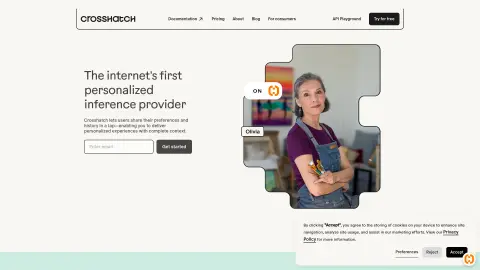
Crosshatch is an API that provides comprehensive real-time user context, enabling developers to create highly personalized applications that make use of both secure user data and instantly shared information. It allows users to integrate their habits, past behavior, and preferences into the applications with a single action, thus creating personalized experiences that take full account of their individual backgrounds and preferences.
How to use Crosshatch?
Integrate the Crosshatch API with just four lines of code. After users log in using Crosshatch, their contextual information can be processed by the language model to generate personalized AI responses that can be presented in any structured format.
The core functions of Crosshatch
Real-time User Context API
Personalized AI Gateway
User permission settings and security measures
Webhook that responds to changes in context
Integration of data related to expenses, travel, and other aspects
Related
WorkPlus HCM
Cloud-based HR and payroll software that encompasses the capabilities of HRIS, HRMS, and HCM, suitable for use in the United Arab Emirates and the Middle East region.
Cubeo AI
No-code AI assistant builder with pre-built AI agents.
SmartBird
An AI virtual assistant for writing, summarizing, translating and correcting text.
Shipper Global
A platform that compares shipping costs and helps users find the best transportation options around the world.
chat4o.ai
An all-round AI platform that integrates an LLM AI assistant with image/video generation capabilities.
Zemith.com
A comprehensive artificial intelligence platform that includes features for chatting, searching, note-taking, document analysis, and image generation.